
"Does mastic gum actually help with H. pylori or bloating?" is one of the most common questions I get, and it's also exploding on TikTok and Google right now. It's a fair question, because there's real published research on mastic gum and H. pylori, unlike the jawline claims floating around the same trend. Here's what the actual studies say, and where the evidence runs out.
What Is H. Pylori and Why It Matters

Helicobacter pylori is a common bacterium that lives in the stomach lining. It infects a large share of the world's population, often without symptoms, but in some people it contributes to gastritis and stomach ulcers, and it's a recognized risk factor for stomach cancer over the long term. Standard treatment is a course of antibiotics, usually combined with an acid-reducing medication, known as triple or quadruple therapy. If you suspect you have an H. pylori infection, that's something to get tested and treated by a doctor, not something to self-diagnose from TikTok.
Symptoms associated with H. pylori can include persistent stomach pain, bloating, nausea, and a burning sensation, though many people carry the bacterium without ever noticing symptoms. Because the symptoms overlap so much with ordinary indigestion, testing (breath, stool, or endoscopy-based) is the only reliable way to know whether it's actually present.
What the Research Actually Shows on Mastic Gum and H. Pylori
The lab evidence here is genuinely strong. In one of the earliest studies, researchers found that crude mastic gum killed H. pylori at low concentrations in vitro, regardless of whether the strain was resistant to the antibiotic metronidazole. Later research confirmed antibacterial activity against clinical H. pylori isolates, and a mouse study found that a mastic extract produced roughly a 30-fold reduction in H. pylori colonization after three months of dosing.
Human trials tell a less clean story. A small randomized pilot study gave patients either 350 mg or 1.05 g of mastic gum three times a day for two weeks and compared the results to standard triple antibiotic therapy. Mastic gum did eradicate H. pylori in some patients, but at a meaningfully lower rate than the antibiotic combination. Separately, at least one earlier clinical study concluded that mastic had no measurable effect on H. pylori load in humans, despite the antibacterial activity seen in the lab.

Put together: mastic gum has demonstrated real antibacterial activity against H. pylori in test tubes and animals, and there's some, but inconsistent, evidence it can help in humans too.
What's Still Uncertain
This is the part that matters most if you're actually dealing with H. pylori. Mastic gum is not a proven substitute for standard antibiotic treatment. The human studies that exist are small, use specific high doses of mastic gum taken multiple times a day (not casual chewing), and generally show lower eradication rates than antibiotics. If you have a confirmed H. pylori infection, the responsible move is to follow your doctor's treatment plan; mastic gum hasn't been shown to reliably replace it.
Some people talk to their doctor about using mastic gum as a complement alongside standard treatment, given its antibacterial and anti-inflammatory profile, but that's a conversation to have with a medical professional, not a decision to make from a TikTok video. Untreated H. pylori can lead to complications over time, so "I'll just chew mastic gum instead of getting tested" isn't a safe substitute for medical follow-up.
What About Bloating and Gut Health?
Bloating gets talked about loosely online. Here's what the research actually covers. The strongest trial here looked at functional dyspepsia, a condition marked by recurring stomach pain, bloating, and a feeling of fullness without an obvious structural cause. In a randomized, placebo-controlled trial, 77% of patients taking Chios mastic gum reported symptom improvement compared to 40% on placebo, with the clearest gains in stomach pain and heartburn.
That's a meaningful result, but it's specific to functional dyspepsia, not bloating in general or other causes like IBS, food intolerances, or SIBO. Mastic's terpene compounds have also shown anti-inflammatory and antioxidant activity in lab studies, and some research suggests they may help support the gut lining, which is a plausible mechanism for why people report feeling less bloated. But there isn't a large body of human trials testing mastic gum specifically for bloating as a standalone symptom, so the honest answer is "promising, with real but limited evidence," not "proven fix."

Bottom Line
If you're asking whether mastic gum can play a supporting role in gut health, or whether it has real antibacterial activity against H. pylori, the research gives a genuine, if mixed, yes. If you're asking whether it can replace antibiotic treatment for a confirmed H. pylori infection, the evidence doesn't support that, and self-treating a suspected infection instead of getting tested is not a good idea.
This article isn't medical advice. If you have persistent bloating, stomach pain, or think you might have H. pylori, talk to a doctor and get tested rather than guessing based on what's trending online.
How People Are Using Mastic Gum for This
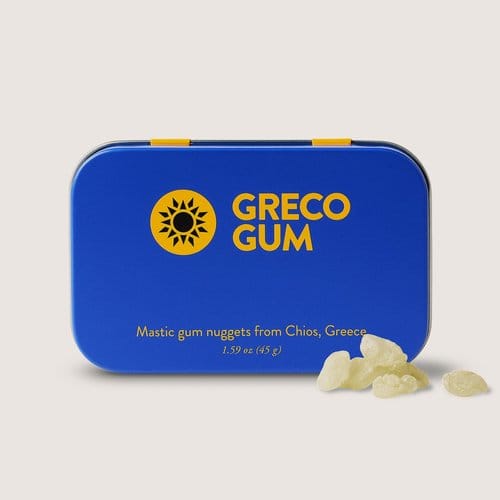
Greco Gum
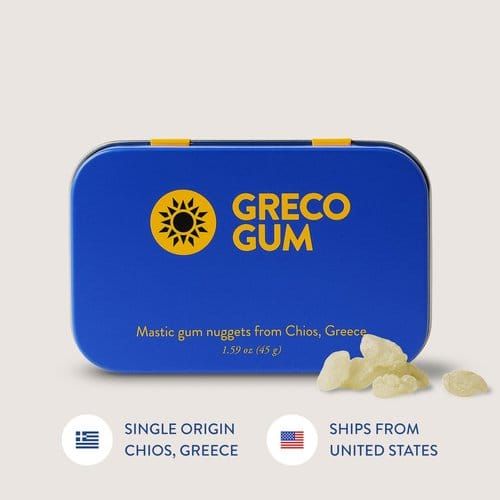
100% pure Chios mastic resin, third-party tested - the brand used in most of the H. pylori research.
Outside of clinical trials, most people trying mastic gum for gut health are simply chewing a few pieces a day rather than following a measured, multiple-times-daily dosing schedule like the ones used in research. That's a reasonable way to try it as a general wellness habit. Casual chewing is a different exposure than the doses tested in the functional dyspepsia and H. pylori trials, so it's hard to say how closely casual use tracks the results seen in those studies.
If digestive symptoms are mild and occasional, that gap may not matter much. If symptoms are persistent, worsening, or accompanied by things like unintended weight loss, vomiting, or blood in stool, that's a signal to see a doctor rather than adjust your gum-chewing routine.
Bloating Has Many Causes
- Functional dyspepsia and general indigestion, where mastic gum has the best supporting evidence
- H. pylori infection, where mastic gum shows lab-level antibacterial activity but inconsistent human results
- IBS, food intolerances (like lactose or FODMAPs), and SIBO, none of which have dedicated mastic gum trials behind them
- Simple diet and eating pace factors, which no supplement, including mastic gum, is likely to fix on its own
Because bloating has so many possible causes, mastic gum being backed by research for one of them (functional dyspepsia) doesn't mean it will help with all of them. If bloating is a regular, disruptive symptom for you, it's worth getting a proper diagnosis rather than assuming any single natural remedy covers every possible cause.
Sources
- PubMed - Huwez et al, "Mastic gum kills Helicobacter pylori"
- PubMed - "In vitro and in vivo activities of Chios mastic gum extracts and constituents against Helicobacter pylori"
- PubMed - "The effect of mastic gum on Helicobacter pylori: a randomized pilot study"
- PubMed - "Mastic gum has no effect on Helicobacter pylori load in vivo"
- ScienceDirect - "Is Chios mastic gum effective in the treatment of functional dyspepsia?"
- PMC - "Current knowledge on alleviating Helicobacter pylori infections through the use of some commonly known natural products"