
I have been chewing Chios mastic gum for years, and one question comes up more than any other: where does this stuff actually come from? This article covers the full story - from the specific soil of a small Greek island to the Ottoman sultans who treated mastic like gold, and how you can tell if what you are buying is the real thing.
Key Takeaways
- True mastic gum (Chios mastiha) comes exclusively from the Greek island of Chios and holds Protected Designation of Origin (PDO) status in the EU since 1997.
- Mastic tears are the natural resin of the Pistacia lentiscus var. chia tree, grown in the Mastichochoria villages of southern Chios, where a unique microclimate and calcareous soil make this resin unlike anything produced elsewhere.
- Harvesting is fully manual: growers score the bark, collect falling resin tears from prepared white soil, then clean them by hand in a process refined over centuries and recognized on UNESCO's Intangible Cultural Heritage list.
- Chios mastic gum has a continuous history stretching from ancient Greece and Rome, through Byzantine and Ottoman periods, to modern cooperative production.
- Below you will find practical tips from my own daily experience on how to identify authentic Chios mastic and avoid generic products that carry the mastic name without the origin.
What Chios mastic gum actually is (from someone who chews it daily)
I am Kristian, and I chew mastic gum every day. This piece is not a product review or a rundown of side effects - those are covered in other articles on my blog. Here, I want to give you the full picture of where Chios mastic comes from and why its history matters.
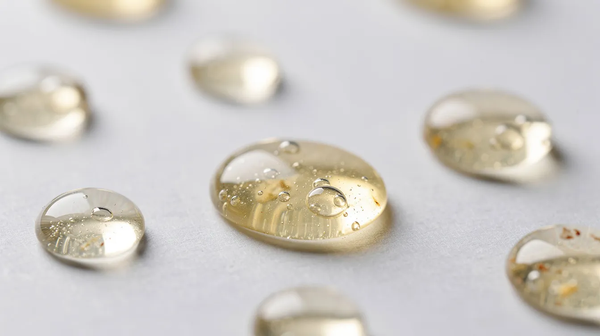
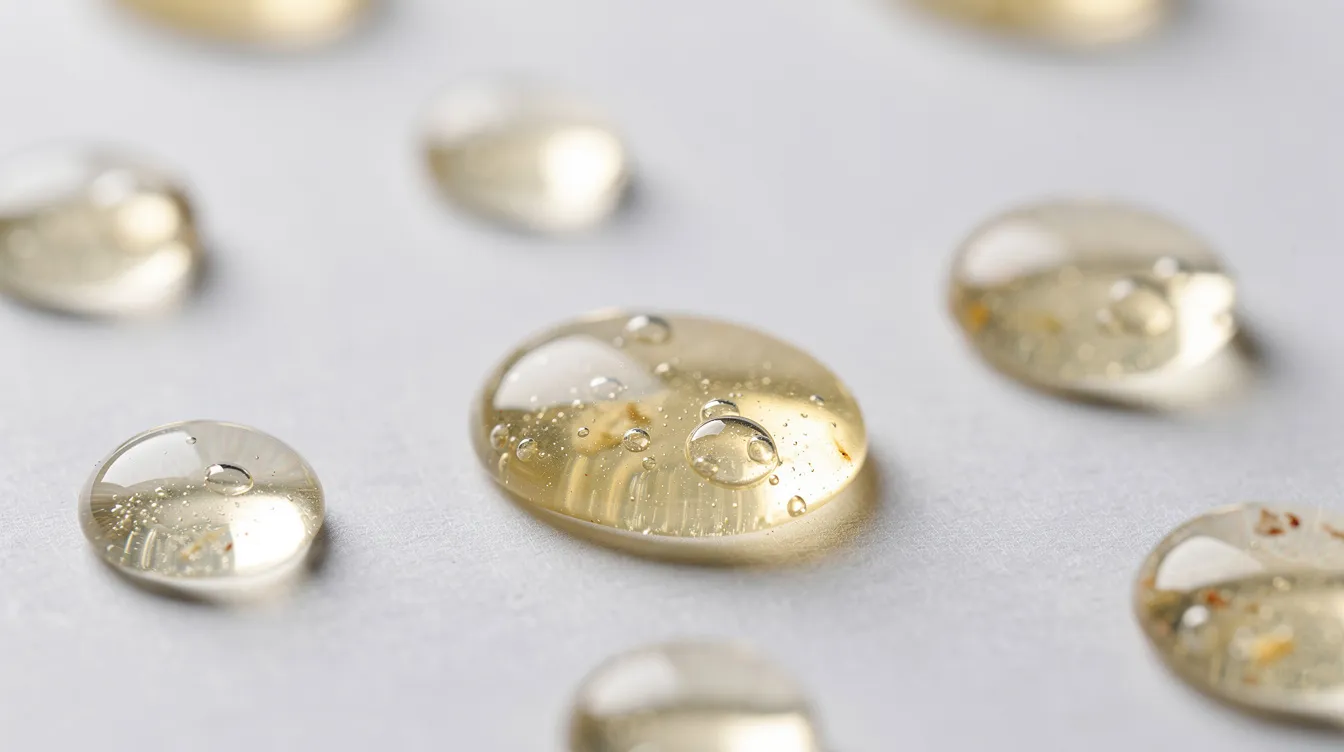
Mastic gum is the hardened resin of the Pistacia lentiscus tree, specifically the var. chia cultivar that grows almost exclusively on the Greek island of Chios. The fresh sap oozes as clear droplets when the bark is scored, then solidifies over days into irregular, translucent mastic tears. Those tears become a natural chewing gum once you soften them in your mouth. Resin comes in two sizes: larger nuggets and smaller droplets. Beyond whole tears, mastic gum is available as powder, and capsules that contain ground mastic powder only, without fillers or additives.
Unlike conventional chewing gum, there is no synthetic gum base here, no added sweeteners or plasticizers. The flavor is resinous - piney, slightly citrus, with notes that shift as you chew. It stays relatively firm compared to what you would find in a convenience store. Mastic gum contains bioactive compounds with anti-inflammatory and antioxidant properties, and preliminary studies indicate it may support cholesterol and blood sugar regulation. A 2022 study showed mastic reduced dyspepsia symptoms, and research suggests it may help reduce Helicobacter pylori bacteria and improve cholesterol levels after 8 weeks. But this article stays focused on origin and history - the science gets its own space elsewhere.
The Greek island of Chios and why it alone produces true mastic
Chios sits in the northeast Aegean Sea, close to the Turkish coast - a rocky island with dry summers, mild winters, and hillsides covered in low scrub and orchards. It is a Mediterranean landscape that feels timeless.
The Pistacia lentiscus tree grows across the Mediterranean basin, from Portugal to Lebanon. But only the specific variety on Chios - Pistacia lentiscus var. chia, a slow-growing evergreen shrub reaching 2-4 meters - produces commercially viable mastic resin. Only Chios produces mastic gum commercially, and that is not marketing spin. It is a fact rooted in the combination of microclimate, soil, and genetics found in southern Chios: low annual rainfall, long dry summers, calcareous soil rich in limestone, and salt-laden sea breezes that help resin harden faster into solid mastic tears instead of remaining sticky. More moisture would prevent proper drying. Locals traditionally speak of the island's unique "breath" - a combination of volcanic ground, heat, and wind.
The word mastic itself traces back to the Greek "mastichein," meaning to chew or to gnash the teeth. And the term Chios mastiha is legally protected in the EU. Producers outside Chios cannot label their resin as such, even if they grow related trees on similar soil.
The Mastichochoria: the mastic villages of southern Chios
The Mastichochoria - literally the mastic villages - are a cluster of 24 medieval settlements in southern Chios that have specialized in resin production for centuries. Around 4,850 growers across these villages are members of the cooperative today, and their families have worked the same plots for generations.
Each village has its own character. Pyrgi is famous for its black and white geometrical facades, a technique called "xysta" that you will not find anywhere else in Greece. Mesta is a fortified village with lanes so narrow that two people can barely pass each other - designed that way deliberately. Olympi sits near dramatic limestone caves. Kalamoti, Vessa, Elata, and Lithi round out a landscape where architecture and agriculture are inseparable.
These villages were built as fortresses to protect the valuable mastic gum from pirates and invaders during Genoese and Ottoman times. Narrow alleys doubled as defensive corridors. Towers watched the coastline. The product was simply too valuable to leave unguarded. When I visit Chios, I always stay near a Mastichochori. Walking through orchards in late summer, the air carries a faint resinous sweetness, and the white ground beneath the trees shimmers in the sun like a prepared stage.

How Chios mastic is harvested: from tree to mastic tears
The first time I watched growers working in August, what struck me was the silence. No machines. Just hands, small tools, and the patience of people who have done this work since childhood.
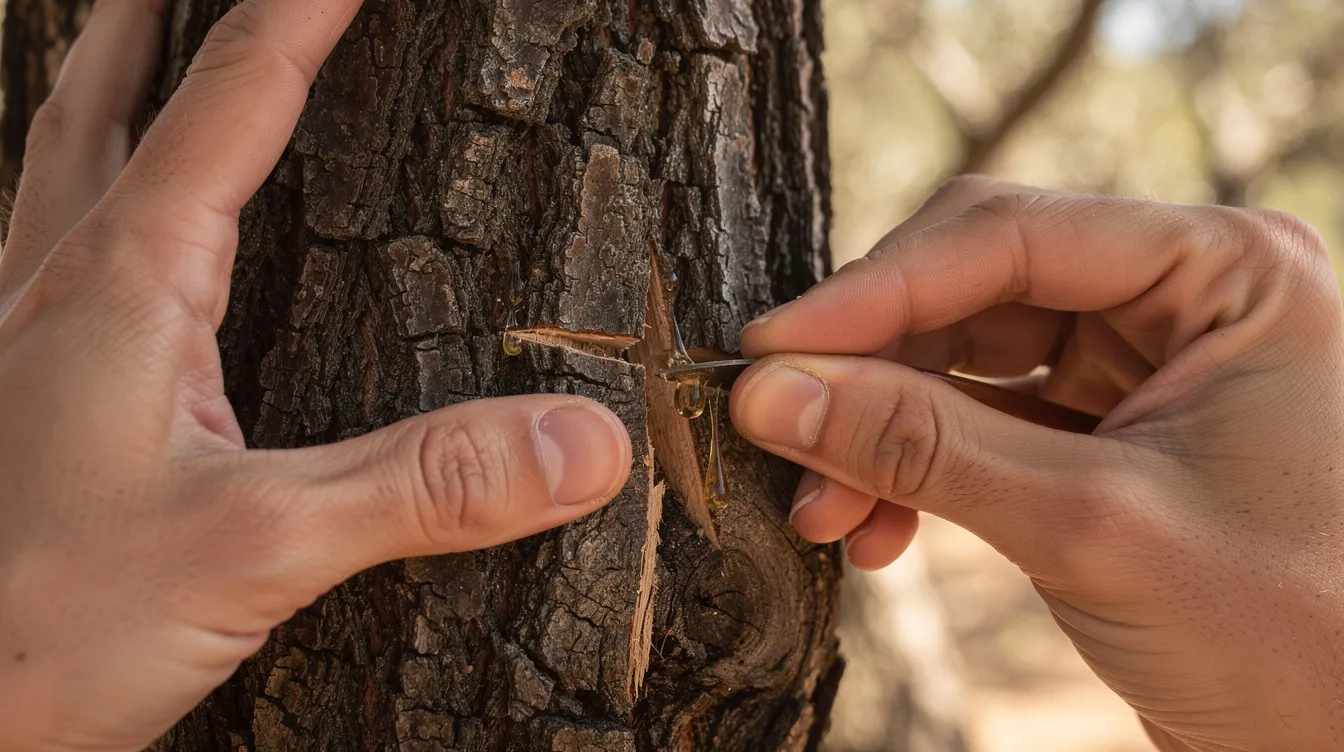
The annual cycle starts in winter with pruning and fertilizing. Spring brings maintenance. By June, the ground under each mastic tree is swept, leveled, and coated with fine white powder called "asprochoma" - often powdered marble or limestone - so that falling drops of sap land on a clean surface. Harvesting mastic gum is a labor-intensive process that involves making incisions in the tree bark using a special tool called a "kentitiri." This scoring process, called "kentima," happens from mid-July onward, with harvesting occurring by hand during July and August and collection extending into September and October.
Over 10-20 days, the clear droplets solidify into mastic tears. Growers then hand-pick the resin crystals from the white ground and from the bark, repeating this several times each season. The tree yields only a few hundred grams of resin annually, which is why the natural product commands its price.
After collection, women traditionally sit together to sort and clean the resin by hand, removing bits of bark and stones, then washing, drying, and grading the tears by size and clarity. This traditional knowledge of Chios mastic cultivation is recognized by UNESCO's Intangible Cultural Heritage list since 2014.
Ancient and medieval history: mastic as the first chewing gum
Long before anyone manufactured conventional chewing gum in a factory, people around the Aegean were chewing resin from the mastic tree to clean their teeth and freshen their breath. Herodotus mentioned mastic in the 5th century BC. Dioscorides described it in detail in his pharmacological works in the 1st century CE. Mastic gum has been used for thousands of years for digestive and oral health purposes, and research confirms it can inhibit plaque accumulation on teeth.
Hippocrates recommended mastic for digestion in 400 BC, making it one of the earliest documented medicinal chewing substances. Later physicians like Galen wrote about it as suitable for treating stomach complaints, coughs, and general tonics. Research suggests mastic gum may help manage symptoms of functional dyspepsia, a connection ancient doctors intuited centuries ago.
In classical Greece, Chios mastic was exported across the eastern Mediterranean - used not only as a natural chewing gum but also as incense, varnish, food flavoring, and medicine. Byzantine sources continued to prize it. The state sometimes regulated its trade, and monasteries on Chios helped organize production, ensuring the knowledge did not dissolve between generations.
Mastic under Genoese and Ottoman rule: from secret to state monopoly
Chios fell under Genoese control in the 14th century. In 1347, the "Maona" was established - a merchant company that tightly managed and taxed the mastic gum trade, treating it as an exclusive monopoly.
After the Ottoman conquest in 1566, mastic became an imperial luxury. The sultans reserved it for the court, harems, and high officials. Mastic growers in the Mastichochoria received special privileges - reduced taxes and a degree of local autonomy - in exchange for delivering their harvest. Theft or smuggling of mastic could be punished severely, sometimes by death. Travelers and chroniclers compared mastic to gold, and it served as a diplomatic gift and spice of elite currency in trade.
The Chios Massacre of 1822, during the Greek War of Independence, devastated the island's population. But the mastic villages survived in large part because the Ottomans themselves recognized their economic weight. After Chios became part of modern Greece in 1912, production continued under new administration, and the root traditions endured.
From local tradition to PDO: modern Chios mastiha protection
The pivotal modern moment came in 1938 when Law 1390 created the Chios Gum Mastic Growers Association, uniting 20 village cooperatives under one organization. This centralized collection, grading, packaging, and marketing from thousands of small growers across the Mastichochoria.
In 1997, the European Union granted Chios mastiha Protected Designation of Origin (PDO) status, extending the same protection to mastic oil and ELMA chewing gum. PDO status means only resin harvested and processed on the island of Chios, according to specific standards, can legally be sold as Chios mastiha in the EU. Today roughly 70% of annual production is exported to around 47 countries. PDO labeling, traceability codes, and specific Greek and EU logos help consumers distinguish authentic mastic gum from generic Mediterranean resin.
How to recognize authentic Chios mastic gum today
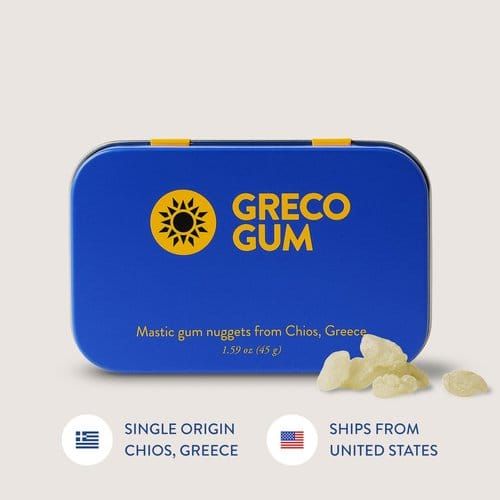
Greco Gum
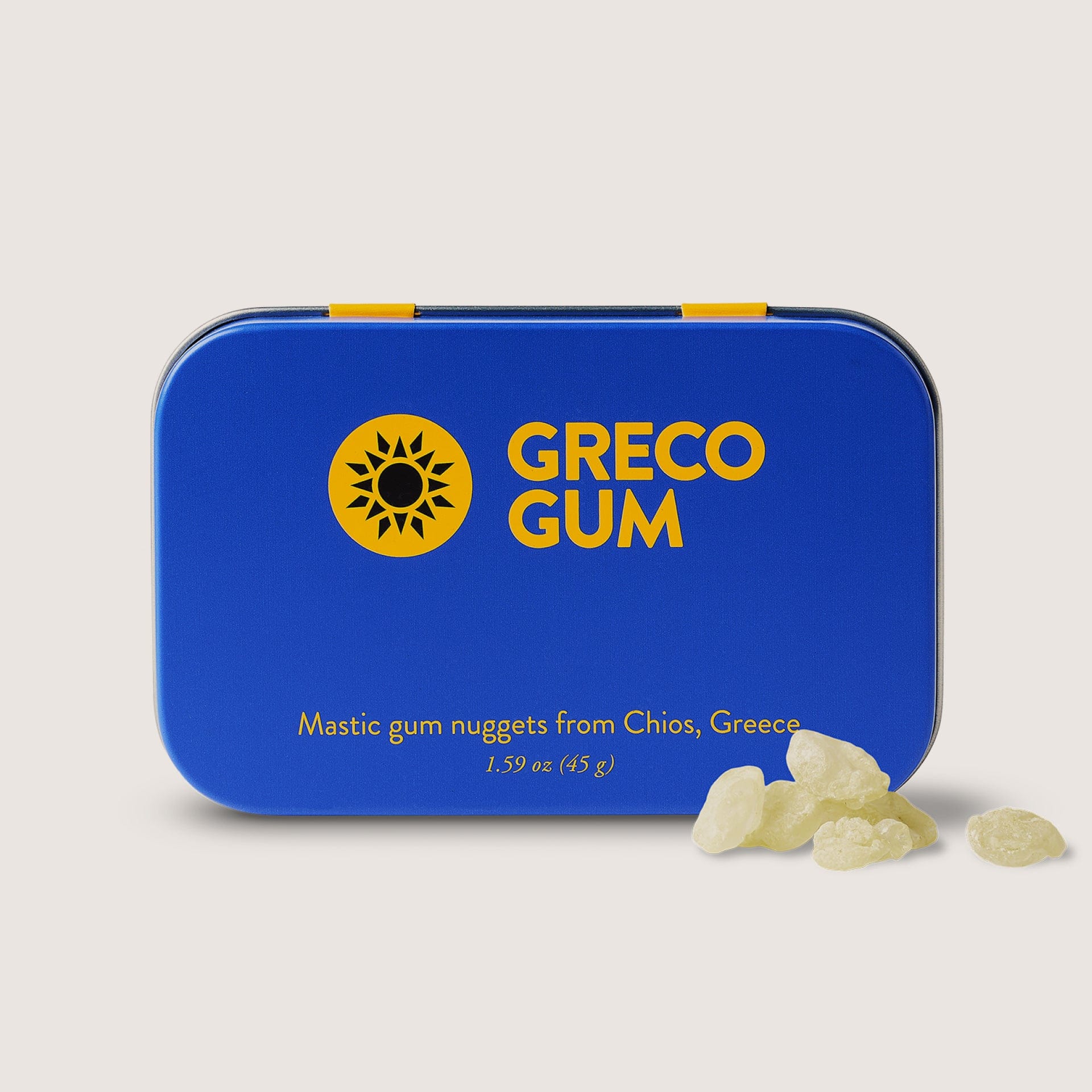
The brand I actually buy from - 100% pure Chios mastic resin, third-party lab tested. Save 25% on the Starter Pack, or grab 4+ tins for 10% off.
As someone who chews mastic gum daily, I have learned to read both the packaging and the gum itself. Here is what to look for:
Label checks: Look for the PDO seal, the wording "Chios Mastiha" or "Mastiha Chiou," Greek text on the package, and branding connected to the Chios Gum Mastic Growers Association. Vague labels saying "mastic flavor" or "Mediterranean mastic" often mean a non-PDO product with additives. Authentic mastic gum should be free of fillers and additives. Mastic gum powder can be taken in sachets or capsules for those who prefer not to chew.
Appearance: Genuine mastic tears are irregular droplets or nuggets, translucent to milky, off-white to pale yellow, slightly sticky when warm. When you open the packet, you should catch a distinct pine-forest aroma.
Chewing behavior: Initially brittle and crumbly, authentic mastic softens and fuses into an opaque, elastic gum within a few minutes. The flavor starts sharp - almost medicinal - then mellows to something smoother and slightly sweet. The hardness gives way as your mouth warms the resin.
Red flags: Perfectly uniform pellets, bright colors, intense sugar flavors, or very cheap prices in large quantities all suggest conventional chewing gum with mastic flavoring rather than pure resin. If it looks like candy, it probably is. Start with a small amount from a trusted source, chew it on an empty stomach if you like, and let your senses be the guide.
Cultural uses of Chios mastic: beyond chewing gum
While I mostly use mastic as chewing gum, its history across Greece and the eastern Mediterranean includes many culinary roles. Mastic gum is used in cooking, cosmetics, and as a supplement. Traditionally, powdered mastic goes into breads, festive desserts like tsoureki, spoon sweets, and the stretchy Turkish-style ice cream known as dondurma. You can grind tears in a mortar with a pinch of salt or sugar to break them down, or freeze them first to make them more brittle and easier to powder. Some combine it with cinnamon or other spice blends in food and beverages.
Mastiha liqueur is itself a PDO spirit from Chios - mastic tears infused in alcohol to create a clear drink with herbal notes, often served chilled. Mastic has also been used historically as incense in Orthodox churches and as a natural varnish for wood and ceramics. These uses maintained demand through centuries, even when synthetic alternatives appeared, preserving the livelihoods of Chios growers and keeping the tradition alive. If you have concerns about digestion or heartburn, consult your doctor, but know that this natural product has a track record few modern supplements can match.
Sources
- Chios Gum Mastic Growers Association. "History of Chios Mastiha." Available at: https://gummastic.gr/en/company/history
- FAO. "Mastic Gum: Harvesting and Trade." Non-Wood Forest Products series. Available at: https://www.fao.org/4/y4351e/y4351e09.htm
- European Commission. "Chios Mastiha / PDO Technical Specifications." Annex II. Available at: https://www.thedtic.gov.za/wp-content/uploads/annexII_7.pdf
- Greek Farms Portal. "Chios Mastic: The Island's Natural Treasure." Available at: https://portal.greekfarms.gov.gr/en/chios-mastic-the-islands-natural-treasure/
- Masticlife. "Mastic Cultivation, Harvest & Production." Available at: https://masticlife.co.uk/pages/mastic-cultivation-harvest-production
FAQ
Here are questions I often get from readers about Chios mastic gum that are not fully covered above.
Is mastic gum really only from the island of Chios?
While mastic trees grow across the Mediterranean, the specific resin known as Chios mastiha with PDO status must come from the island of Chios, mainly its southern Mastichochoria region. Other areas may produce similar resins, but legally and traditionally, "Chios mastic gum" refers only to the product of this one Greek island.
How long can I store Chios mastic tears?
If kept in an airtight container away from heat and direct sunlight, mastic tears can hold their quality for 1-2 years or more. I store mine in a cool cupboard. Refrigeration is optional but helpful in warm climates - just make sure the container is sealed well, since too much moisture can affect texture. They will not melt at room temperature but can get softer in summer heat.
Does authentic Chios mastic always come as irregular tears?
Traditional mastic is sold as irregular tears, but authentic Chios mastiha is also ground into powder, dissolved into liqueur, or processed into prepared chewing gum pellets in Greece. What matters is PDO origin and labeling, not shape alone. For the purest experience, I recommend starting with whole mastic tears and working from there.
Can I visit the mastic villages and see the harvest?
Visitors can travel to Chios and the Mastichochoria, especially in July and August when the harvest is underway. Access to specific orchards depends on growers' permission, but the Chios Mastic Museum and cooperative tours explain the process in detail and sometimes include live demonstrations. It is worth the trip.
Why does my mastic gum sometimes taste very strong or even slightly bitter?
Flavor intensity varies with the age of the tears, the specific tree, and storage conditions. Fresh, high-quality Chios mastic often starts sharp and resinous before mellowing as you chew. In my experience, smaller droplets tend to be more intense than larger nuggets, but the strong first impression usually softens within a couple of minutes of chewing.