
I may earn a small commission if you buy through my links, at no extra cost to you. Disclosure
Kindle Unlimited (now called Kindle+) is worth it if you read at least one ebook a month and your favorite genres are well covered by its catalog, especially romance, sci-fi, thrillers and indie fiction. It is not worth it if you mostly read new releases from the big publishers, because Penguin Random House, Hachette and Macmillan do not offer their titles in it.
The price is $11.99 a month in the US plus any state tax, with a 30-day free trial for eligible new members. Amazon renamed the service Kindle+ on 22 October 2026 and left the price unchanged. This guide covers what the subscription includes, the 20-title limit, how much audio you really get, and who should pick something else. For the full price history see my page on how much Kindle Unlimited costs.
This Kindle Unlimited review is based on Amazon's own page and on reviewers and comparison sites, read on 18 October 2026. I did not take out a subscription to write it, so this is a research-based verdict, not a hands-on test. Amazon's help pages block automated access, so the limit details below come from an Amazon-hosted help page, reviewers and comparison sites, all linked at the end. The catalog claim comes from Amazon's own Kindle Unlimited page. I updated it on 28 October 2026 after the rename to Kindle+, checking Amazon's Kindle+ explainer and press coverage from 22 and 23 October 2026. Check the current terms before you subscribe.
Key takeaways
- Kindle Unlimited, renamed Kindle+ on 22 October 2026, costs $11.99 a month in the US plus tax, with a 30-day free trial for eligible new members.
- Amazon's own Kindle Unlimited page said "over 5 million eBooks and audiobooks" when I read it on 18 October 2026, and its Kindle+ explainer now says millions. Reviewers earlier in 2026 cited over 4 million.
- You can borrow up to 20 titles at a time. From 22 April 2026 magazine issues count toward that limit, according to an Amazon help page.
- Penguin Random House, Hachette and Macmillan offer none of their titles. HarperCollins and Simon & Schuster offer only some.
- Thousands of titles have audio narration, including human-narrated ACX titles and AI-narrated Virtual Voice titles in the US, but narration is available on selected titles only.
- If you listen more than you read, Audible or a library app is usually better value.
Kindle Unlimited is now Kindle+: what changed
Amazon renamed Kindle Unlimited to Kindle+ on 22 October 2026 (see Amazon's Kindle+ explainer). The verdict below stands: the US price is still $11.99 a month plus taxes and the limit is still 20 titles at a time. What changed is audio. 9to5Mac reports that the audiobook library is larger and includes AI-narrated titles, and Written Word Media explains that Virtual Voice audiobooks join automatically when an author enrolls an ebook in KDP Select, while human-narrated ACX titles join only if they meet Amazon's conditions. The new audiobooks are US-only at launch, with no date for other countries. If audio is your main reason to subscribe, sample a few AI-narrated titles during the free trial first.
Is Kindle Unlimited worth it? The short answer
A short answer: yes for a voracious reader of genre fiction, no for someone who reads a few books a year. Is Kindle Unlimited worth it for you? Count how many books you read a month and how many of them are in the program. The Kindle Unlimited subscription pays for itself when you read two or three books a month that you would otherwise buy.
Kindle Unlimited review in short
Kindle Unlimited, often shortened to KU and now branded Kindle+, is a subscription service that lets you borrow ebooks and some audiobooks and magazines for a monthly fee. KU books are borrowed, not owned. The Kindle Unlimited library is large and offers an extensive library of popular books and series, but it is strongest in self published books and genre fiction, and weakest in books from the major publishers. Whether it is worth it depends on your reading habits, so I give you a test further down.
What Kindle Unlimited is
Kindle Unlimited, which Amazon renamed Kindle+ on 22 October 2026, is Amazon's all-you-can-read subscription. You borrow ebooks and a selection of audiobooks, magazines and comics, with no due dates, and read them on a Kindle, the Kindle app or a tablet. Titles are in the program because the publisher or author has opted in, so the catalog is wide but uneven.
It is separate from Prime Reading, which is included with Amazon Prime and has a much smaller rotating selection.
How much Kindle Unlimited costs
The monthly price is $11.99 plus applicable state tax. That is $143.88 a year before tax. The price rose from $9.99 on 11 May 2023, the first change since the service launched in 2014, and I found no 2026 change in any source I checked, including the coverage of the Kindle+ rename.
Amazon sometimes discounts longer prepaid plans and runs promotions on Prime Day and Black Friday, and new Kindle e-readers often come with a few months included. The full breakdown is in How Much Is Kindle Unlimited.

Kindle Unlimited vs buying books vs the library
There are three ways to read the same book, and each has a different cost.
- Buy the ebook. You pay full price and keep it. Good for books you will reread.
- Subscribe to Kindle Unlimited. You pay the monthly fee and borrow KU titles. No extra cost per book, but the book leaves when you cancel.
- Use a library. A local library or public library app lends ebooks and library books for free, with a wait on popular titles.
If you only read physical books, none of this applies, and a library card is cheaper still. A library gives you free books, and some library apps also lend audiobooks. If you read both, a mixed approach works: borrow the series from KU and buy the one-off books you want to keep. Keep a wish list of the books you want, then check how many are in the program before you pay. The free trial is the place to do it.
The break-even test
The maths is simple. At $11.99 a month you break even if you would otherwise buy one ebook at about $12 in that month, or two at about $6. If the books you want cost $3 to $5 each, you need to read three or four a month for the subscription to win.
That is why the program suits voracious readers of series fiction. An avid reader who finishes a book a week will save money, and a reader of romance books or science fiction (sci fi) gets the most from the catalog because many series in those genres are in the program. If a title is not in KU, you pay the full price on top of the fee, so the extra cost of a missed book is the full price of the ebook. Someone who reads three books a year will not.
What you get with Kindle Unlimited
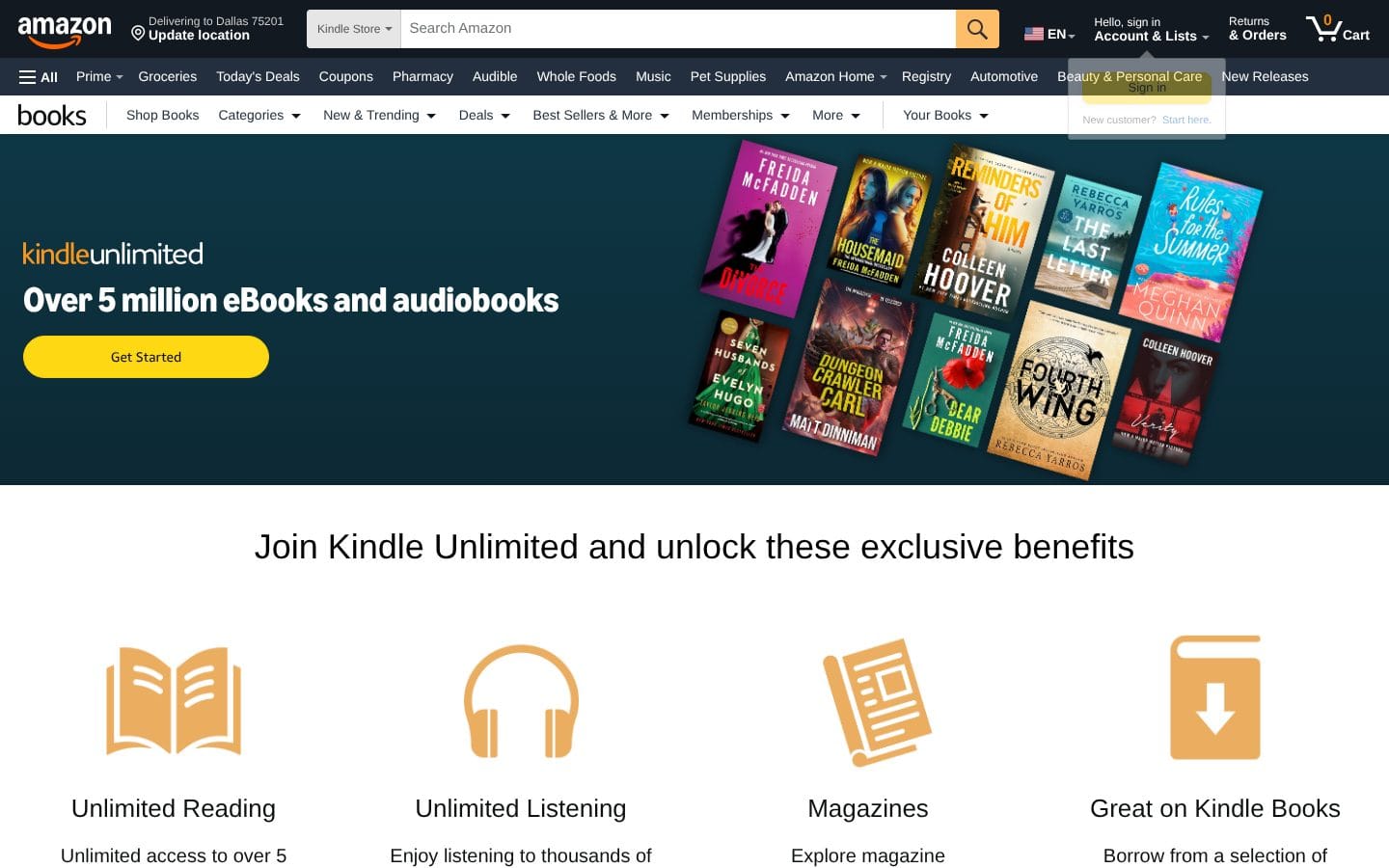
Amazon's page said the membership covers over 5 million digital titles when I read it on 18 October 2026, and its Kindle+ explainer now says millions, including best sellers, popular series and classics. How many books you can actually read is a different matter, because the catalog counts every self published title.
- Ebooks. The bulk of the catalog, with a large share of self-published and indie titles.
- Audiobooks. Thousands of titles with narration, shown with a headphone icon. Since the rename this includes human-narrated ACX titles and AI-narrated Virtual Voice titles, US only for now. You can filter the Kindle Unlimited store by audiobooks.
- Magazines and comics. Included, but magazine issues now count toward your 20-title limit.
- No due dates. You keep a book for as long as you stay subscribed, within the 20-title cap.
Self published books and new authors
A large share of the catalog is self published, and that is a strength. If you like discovering new authors, KU makes the risk small: you borrow, you read a few chapters and you return. The trade-off is that quality varies, and the books from the large publishers are mostly missing.
What Kindle Unlimited does not include
This is where most people are disappointed. Penguin Random House, Hachette and Macmillan offer none of their titles. HarperCollins and Simon & Schuster offer select titles only. That excludes many books on the traditional bestseller lists. For popular audiobooks specifically, see the best Audible books.
Titles also leave when the publisher opts out, and every borrowed book disappears if you cancel. Your highlights and notes stay in the cloud.
The 20-title limit
The Kindle Unlimited books you borrow sit in your Kindle library until you return them or cancel.
You can hold 20 borrowed titles at once. An Amazon help page says that from 22 April 2026 magazine issues count toward the 20, and that any books over the limit were returned automatically by 30 July 2026. This help page sits on an unusual Amazon subdomain, so confirm it on Amazon's main help pages if the limit matters to you.
For most readers 20 is plenty. It only bites if you collect a long series or subscribe to several magazines.
Are Kindle Unlimited audiobooks any good?
Partly. Amazon's page promises listening to thousands of books, not the whole catalog. You can switch between reading and listening on books that have narration, but narration is available on selected books only. Since the rename, some of it is AI-generated through Virtual Voice, so listen to a sample first. If audio is your main reason to subscribe, an audio-first service is a better fit. My Audible review and the best audiobook subscriptions comparison cover the options.
Kindle Unlimited audiobooks are the titles that carry narration, including human-narrated ACX titles and AI-narrated Virtual Voice titles. Audible's own pages list Standard at $8.99 a month and Premium at $14.95 a month. Kindle Unlimited at $11.99 sits between them, but it is ebook-first.
Which Kindle is best for Kindle Unlimited?
You do not need a particular device, and you can download the free Kindle app on a phone or tablet. KU works on any Kindle and in the free Kindle app on phones and tablets, so the best Kindle for KU is the one you already read on. If you read on a phone and want an e-reader, that is a separate decision from whether to subscribe. Amazon also sometimes bundles a few months of KU with a new e-reader, which lowers the cost of trying it.
Kindle Unlimited alternatives
| Service | Price | Best for |
|---|---|---|
| Kindle Unlimited (now Kindle+) | $11.99 a month | Ebook readers of romance, sci-fi, thrillers and indie fiction |
| Prime Reading | Included with Prime | Light readers who already pay for Prime |
| Everand | $11.99, $16.99 or $28.99 a month depending on tier | Readers who want audio titles, ebooks and magazines in one app |
| Audible Standard | $8.99 a month | One audiobook a month on a lower budget |
| Audible Premium | $14.95 a month | One audiobook a month that you keep |
| Library apps | Free with a library card | Anyone who can wait for a hold |
Everand's prices are from a comparison site, and its lower tiers limit how many premium audio titles you can unlock each month, so read its terms. A library app is the cheapest alternative of all, and the only one that costs nothing.
Who should get Kindle Unlimited
Get it if you:
- Read at least one ebook a month, ideally in series.
- Like romance, sci-fi, fantasy, thrillers or indie nonfiction, or enjoy discovering great books outside the best seller lists.
- Own a Kindle or use the Kindle app daily.
- Want a free 30-day trial to test your reading list against the catalog.
Skip it if you:
- Want to build an extensive library of books you own.
- Mostly read new releases from the large publishers.
- Prefer audio. Compare Audible's plans and deals first.
- Read fewer than 10 books a year.
- Want summaries of nonfiction books instead of full books. Try Blinkist instead.
How to test Kindle Unlimited for free
Start the 30-day trial and write down 10 books you actually want to read. Search each in the Kindle Unlimited store before you pay anything. If seven or more are included, subscribe. If three are, borrow from a library instead and cancel before the trial ends.
To cancel, go to Your Account, then Manage your Kindle+ Subscription (formerly Your Kindle Unlimited), and choose Cancel Kindle+ Subscription. Access continues to the end of the billing period, and payments are generally non-refundable.
Frequently asked questions
How many books are in Kindle Unlimited?
Amazon's page said over 5 million eBooks and audio titles when I read it on 18 October 2026, and its Kindle+ explainer now says millions. Reviewers earlier in 2026 cited over 4 million. Those counts include indie books and magazines, so treat them as a ceiling.
Is Kindle Unlimited worth it for one book a month?
Yes, as long as that book would cost you about $12 or more to buy. If your books cost $4, you need three a month.
Does the Kindle Unlimited subscription include audio titles?
Some. Thousands of titles carry narration, marked with a headphone icon, including AI-narrated Virtual Voice titles and human-narrated ACX titles in the US. Narration is available on selected books only, not across the whole catalog.
Does Kindle Unlimited have new releases?
Often from indie authors, rarely from the large publishers. Penguin Random House, Hachette and Macmillan do not offer their books.
Can I read Kindle Unlimited books without a Kindle?
Yes. They work in the Kindle app on phones, tablets and computers.
What happens to my books if I cancel?
Borrowed books are removed once your billing period ends. Highlights and notes stay in your Amazon account.
Is there a monthly fee on top of the price of each book?
No. The monthly fee covers every KU title you borrow, up to the 20-title limit. Books outside the program are at full price.
Verdict
Kindle Unlimited, now Kindle+, is worth the money for heavy readers in genre fiction and poor value for everyone else. So, is Kindle Unlimited worth it? Only if you will use it every month. Use the free trial, test your own reading list and decide with numbers rather than the catalog headline.
Sources
- Cloudwards: What is Kindle Unlimited
- dealnews: Kindle Unlimited cost
- Amazon help page on Kindle Unlimited limits
- Text to Lab: Everand vs Kindle Unlimited
- Everyday Reading: Kindle Unlimited
- Good e-Reader: Kindle Unlimited price increase
- Jane Friedman: Kindle Unlimited price increase
- Audible FAQ
- Amazon: Kindle+ explainer (updated 22 Oct 2026)
- 9to5Mac: Amazon unveils Kindle+ subscription
- Android Central: Kindle Unlimited is now Kindle Plus
- Written Word Media: Kindle+ for authors